
From first move to review
Open the page and play chess against the AI. Pick White or Black, choose a strength, and the game begins. While the AI thinks, the sidebar shows its search depth and recommended line in real time. Hints and undo are there whenever you need them, and when the game ends you can replay it move by move.
Tips for your first games
If you're new to chess, start with Gentle. It makes plenty of mistakes, which gives you room to get comfortable with how the pieces move, how check works, and when to capture. Once you can reliably spot your opponent's direct threats, move up to Beginner or Advanced. You can change strength mid-game without starting over; the new level takes effect on the next move.
On your turn, work out what your opponent's last move was trying to do before you choose your own. Still unsure? Tap Hint and compare. If the hint differs from your plan, there's usually a threat you haven't seen yet. After the game, open the replay and step through it from the start. Find the move where you first fell onto the back foot, and make that the thing to watch for next time.
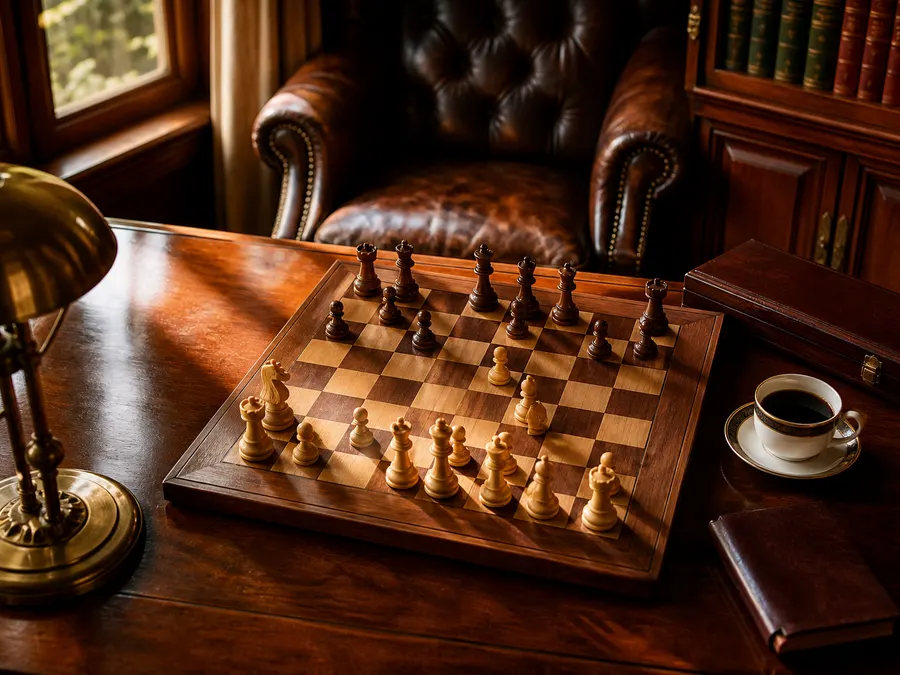
Multiple strengths, switch any time
Gentle slips often and lets many of your mistakes go unpunished. Each level up, the AI gets better at picking off undefended pieces and makes fewer errors of its own. Master is the strongest level, and on a computer you can give it up to a minute per move. Try playing a position on a low level first, then replay it on a higher one to see where a stronger opponent hits back.

See the AI's plan
While the AI thinks, the sidebar's recommended line lists the moves it expects to come next, along with search depth, node count, and speed. The line reflects the AI's current judgment and updates as the position changes. Set it beside your own plan and start from the first point where they split. That's often where you'll find a check you missed, or a defense your opponent had ready all along.
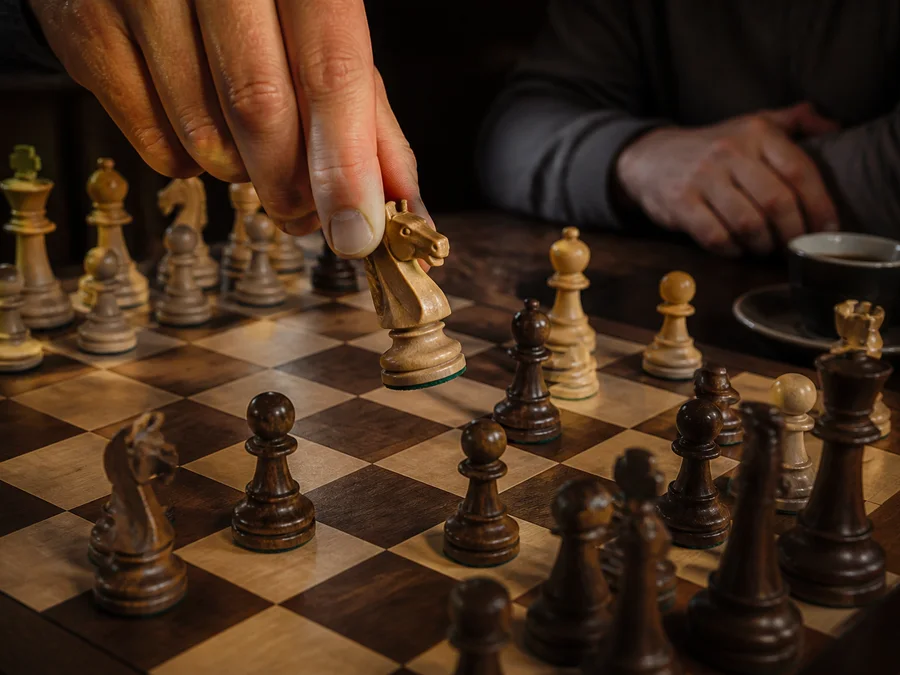
Hints, undo, and full-game replay
A hint marks a suggested move on the board but never plays it for you; whether to follow it is your call. Hints are calculated at your current level, so Gentle gives Gentle-level advice. If you realize a move went wrong, undo it and try another to see how your opponent responds. Once the game is over, replay walks through every move in order, which makes it easy to compare different ways of playing.
AI levelsfrom Gentle to Master
Live analysisdepth and recommended line
Undotake it back, try another move
Full replayreview every move after the game
Common Questions
What chess rules does this site use, and when is the game a draw?
This site uses ordinary chess rules. White moves first, and the players move in turn. Checkmate wins. Stalemate is a draw, as are fifty moves with no capture and no pawn move, and endings that cannot be won, such as king versus king or king and one minor piece versus a lone king. Castling, en passant, and pawn promotion are part of the same rules.
How is this AI different from a typical browser chess opponent?
The AI here is the open-source Stockfish engine with a neural network. It works out later variations in your browser as you play, and the sidebar shows the search depth, the recommended line, the node count, and the search speed. A lot of web chess only scores material and piece squares, or it looks only a little way ahead, so the thinking stays hidden. Here you can watch that search. If the browser cannot run multiple threads, play continues on the same engine in one thread, without splitting the search across several.
Why does a position that looks fine collapse on the next move?
It is usually not the lost piece or the checkmate appearing out of nowhere. An earlier move has already left a piece undefended, or let a knight attack two targets at once. An undefended piece can be taken at once. Of the knight's two targets, you can save only one per turn. Stop the replay on that move. Look at which piece has no defender, and at the two squares the knight attacks.
Does the first move have to be e4?
No. This site does not require e4 on the first move, and that square has no extra score. Starting with another pawn, or developing a knight first, leads to different later choices. Playing e4 is only one of those choices. It does not make the position winning by itself.
How can I use hints, undo, and replay without simply following the answer?
List two candidate moves first and say which threat each one meets, then open the hint and compare. If it differs, decide whether it is answering an immediate threat, taking a loose piece, or improving a piece's square. Undo is for going back to the fork and testing the other judgment. Replay should look for the first move that lost the initiative, not only the final result.
Can I play properly on a phone or tablet?
Yes. The board resizes to fit the screen, and hints, undo, and replay all work. If the device can't run multiple threads, the AI switches to a single thread automatically and the game carries on.
How do I play a friend instead of the AI?
If you're together, open Two Players and take turns on one device. If you're apart, create an online room and send your friend the room link.
Can I change the AI strength in the middle of a game?
Yes. Switching strength keeps the current position. The next move is calculated at the new strength. To see how a tougher opponent handles the same position, play it once on Gentle, then move up and watch where the counter starts.
If I play Black, who moves first?
White moves first. If you sit as Black, the AI opens. If you sit as White, you open. Changing color after the game has started begins a new game and clears the current one. It does not swap the colors on the position you already have.
How is Master different from the other strengths?
Gentle through Strong use the smaller network. Master appears only on a computer. It loads a network of about 94MB, and you can set how long it thinks on each move, up to one minute. Phones and tablets do not offer Master. Strong is the highest strength there.
