
The most transferable chess skill is not a memorized sequence but a decision process you can reuse in unfamiliar positions. This guide covers candidate moves, tactical checks, material, pawn structure, endgame transitions, and post-game review, with practical questions for every stage.
Candidate-move selection
Many mistakes come from thinking in the wrong order: capturing the first available piece or calculating only the line you hope to see. A consistent process makes you address the position's immediate demands before comparing plans.
- 1Assess the last move
What did your opponent attack or defend, and which file, diagonal, or square did the move weaken?
- 2Scan forcing moves
Examine checks, captures, and direct threats in that order. Resolve the position's immediate demands before considering strategic plans.
- 3List candidate moves
Keep two or three candidates: an active move, a solid move, and, when useful, an option that simplifies the position.
- 4Calculate and verify
Calculate each variation until the position stabilizes, then perform a final blunder check from your opponent's perspective before playing the move.
Before playing the move, picture it on the board and scan from your opponent's perspective for checks, captures, and forks. This catches moves that execute your idea while creating a new tactical weakness.
Evaluate beyond material
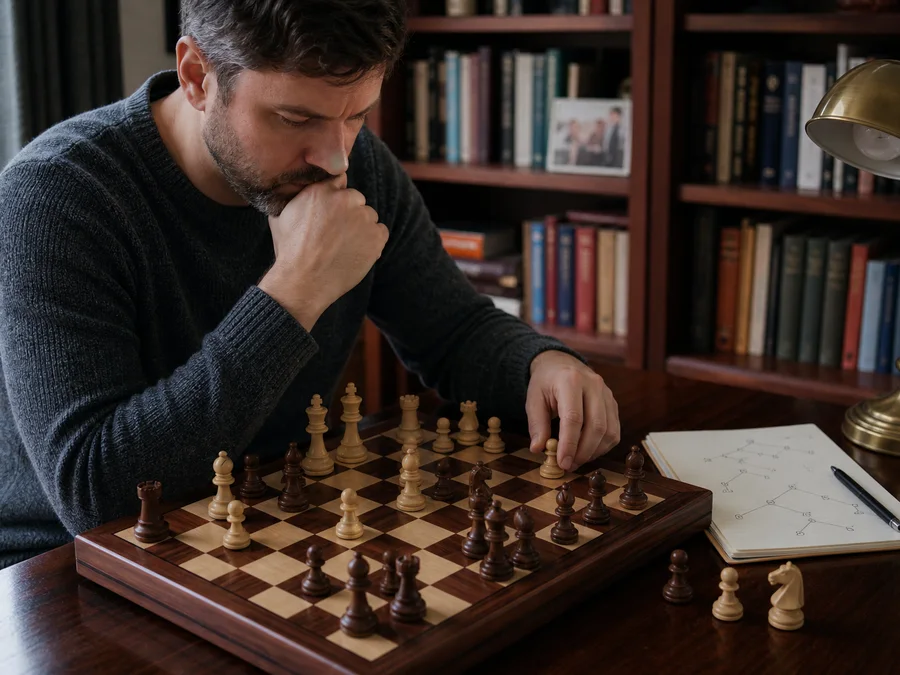
Four-factor evaluation
Compare king safety, material, piece activity, and pawn structure. When they point in different directions, address the most urgent factor first. A long-term pawn-structure edge means little during an attack on your king; in a quiet position, activity and weak squares are more likely to shape the plan.
An evaluation does not end with saying White or Black is better. Turn the conclusion into a plan: trade an attacking piece, contest an open file, blockade a passed pawn, or improve your worst-placed piece.
| Piece | Typical value | Position-dependent factors |
|---|---|---|
| Pawn | 1 | Pawn structure, passed pawns, and promotion potential can change a pawn's practical value. |
| Knight / bishop | About 3 | Knights often thrive in closed centers; bishops gain scope in open positions, where the bishop pair can become a lasting advantage. |
| Rook | About 5 | Rooks become much stronger on open files and the seventh rank. |
| Queen | About 9 | The queen has enormous range, but early development can lose tempi when the opponent attacks it. |
Calculate forcing moves
Checks, captures, and direct threats restrict your opponent's replies, making them natural starting points for calculation. Looking at checks first does not mean every check is good; list them, then test each one against every legal response.
Count attackers and defenders
Count every attacker and defender at the point of contact. Remember that a pinned piece may not be able to recapture legally.
Exploit overloaded defenders
A piece that must defend two important targets may be overloaded. Exchanging or deflecting it, or obstructing its defensive line, can be more effective than attacking the target directly.
Calculate to a quiet position
Do not stop after the first capture. Calculate recaptures, counterattacks, and any zwischenzug or other intermediate move until no immediate check or capture remains, then evaluate the result.
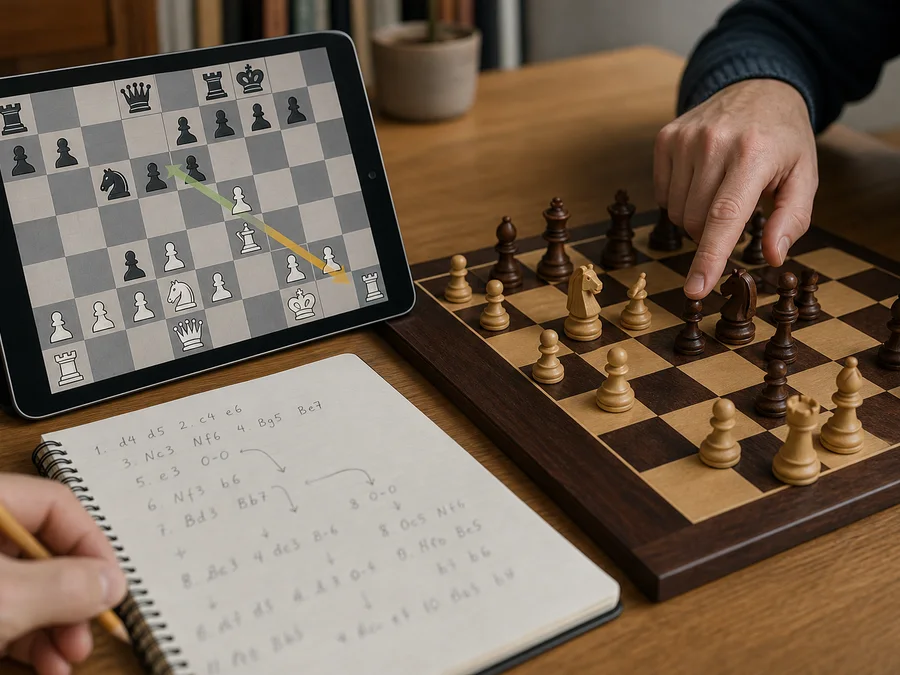
Test your analysis with hints
Choose a main candidate and an alternative before opening the hint. If the recommendation differs, do not compare only the first move. Calculate a short line with each side's best replies and find where the evaluations truly diverge.
Most disagreements have a familiar cause: a missed forcing move, a miscalculated exchange sequence, an overlooked intermediate move, or an attack with no follow-up. Classifying the error is more useful than memorizing one game's best move.
Read the pawn structure
Pawns cannot move backward, so pawn structure is one of the position's most lasting features. Before choosing where to attack, identify which flank offers space, which files may open, and which weak pawn requires long-term defense.
- Isolated pawn:An isolated pawn has no friendly pawn on an adjacent file. It can become a fixed target, but it may also provide open files and active piece play.
- Backward pawn:A backward pawn is difficult to advance and lacks support from a neighboring pawn. The square in front of it often becomes an enemy outpost.
- Passed pawn:A passed pawn has no enemy pawn ahead on its own or an adjacent file. In the endgame, support it with the king or another piece and force your opponent to commit a blockader.
- Pawn chain:Attack a pawn chain at its base, which is not protected by another pawn, while taking care not to concede weak squares to an enemy knight.
Find outposts that enemy pawns cannot challenge, then identify a knight or another piece that can occupy them. When no immediate tactic exists, improving your worst-placed piece is usually a reliable candidate move.
Plan the resulting endgame
Trading queens or a pair of rooks does not automatically produce a favorable simplification. Check whether the king can become active, which flank holds the passed pawns, whether either side has an outside passed pawn, and whether the remaining bishop controls the critical promotion square.
Activate the king
Once the queens are off, the king should usually move toward the center. In the endgame it is a fighting piece that attacks and blockades passed pawns.
Place the rook behind the passed pawn
Whether supporting your own passed pawn or stopping an enemy pawn, a rook behind it usually retains maximum activity.
Calculate the pawn race
Do not judge a pawn race by distance alone. Count the moves to promotion and account for promotion with check, the opposition, and diagonal control.
Review critical decisions
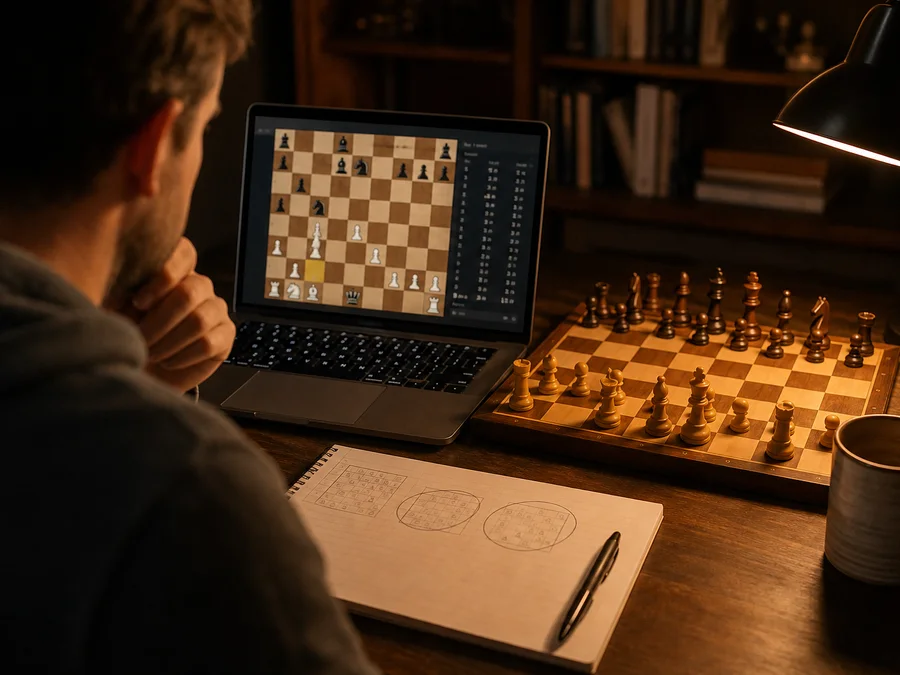
One lesson per game
Replay the game without hints first. Mark positions where you spent much longer than usual, where your evaluation changed sharply, or where the result differed from your expectation. Analyze the earliest such position first, because later errors may simply follow from it.
Turn the lesson into a condition you can apply next game: "When my opponent moves a pawn, check which queen or bishop line it opened," rather than the vague instruction, "Do not be careless."
Review sequence
- Without using hints, mark the positions where you genuinely hesitated.
- For each critical position, list two or three candidate moves again and write down the main variations.
- Then compare your work with the hint and record the first difference in calculation or evaluation.
- Classify the error as tactical, positional, time-management, or knowledge-related, and carry just one lesson into the next game.
Review the complete rulesStudy the position with another player
Questions
Do I need to calculate deeply on every move?
No. In quiet positions, start by improving your worst-placed piece. Calculate more deeply when checks, captures, direct threats, or other concrete tactics arise. Stop when the position stabilizes and no immediate tactic remains, not after an arbitrary number of moves.
Why can I still lose with a material advantage?
Material is only one part of an evaluation. An exposed king, poor piece coordination, a dangerous passed pawn, or a complete loss of initiative can offset a material advantage. When ahead, neutralize counterplay before exchanging your opponent's active pieces.
Should material values alone decide an exchange?
No. Also consider the resulting pawn structure, king safety, piece activity, and endgame. Trading a bishop for a knight may damage your opponent's pawn structure, but it may also surrender the bishop pair. Evaluate the resulting position.
How can I use hints without becoming dependent on them?
Choose your own candidate moves before opening the hint. Find the first point where your analysis differs: did you miss a forcing move, misjudge an exchange, or overlook a defensive resource? Understand that difference before deciding whether to play the suggested move.
How much opening theory do I need to memorize?
First understand central control, development, king safety, and pawn structure, then learn the typical plans in common positions. Memorizing moves without their purpose leaves you unable to select candidate moves once your opponent deviates from theory.
Should I analyze a game myself before checking the engine?
Yes. First mark the positions where you hesitated, changed your evaluation, or missed a tactic. Then check them with hints or an engine. Reading engine moves from the start may show the answer without revealing where your own thought process failed.
